Akbar and Birbal Story: Water in the Well
| Detail | Info |
|---|---|
| Series | Akbar Birbal Stories |
| This Story | Water in the Well (also called “The Farmer Who Bought a Well”) |
| Characters | A poor farmer, a cunning well-owner, Emperor Akbar, Birbal |
| Setting | Akbar’s court, Mughal-era India (16th century) |
| Source | Traditional Akbar-Birbal folk-tale — passed down orally, not found in Abul Fazl’s Akbarnama or Ain-i-Akbari (see FAQ below) |
| Reading Time | 11 minutes |
| Main Lesson | Cleverness beats dishonesty, and the law protects the honest |
Quick Facts
In this Akbar and Birbal Story: Water in the Well
🤔 Unanswered question: if you own the well but not the water, whose water is it, really — and where is that water supposed to go?
😲 Shocking fact: the well-seller thought he had found the perfect loophole — “I sold you the well, not the water” — a trick clever enough to fool the farmer and the royal court itself.
A 400-year-old Akbar Birbal story in English for kids — and the one lesson about fine print your child needs before their first phone contract.
Picture this: your parents finally save enough to buy a new house — the one with the big backyard you’ve been dreaming about. They shake hands with the salesman, sign the papers, hand over the check. The next morning, you run outside to try the borewell — and the same salesman is standing at the gate, clipboard in hand, smiling.
“I sold your parents the house,” he says. “Nobody said anything about the borewell underneath it.”

Sounds like something out of a sketchy contractor’s fine print, doesn’t it? It’s actually the plot of a story Indian grandparents have been telling for four centuries — and it holds up so well that it could be a plotline on a courtroom drama tonight.
A Thought for Parents: You don’t need to have grown up hearing these stories yourself to pass this one on. Think of it as the original “read the terms and conditions” lesson — just with an emperor instead of a EULA pop-up.
The Story: A Farmer, a Well, and a Trick 400 Years in the Making
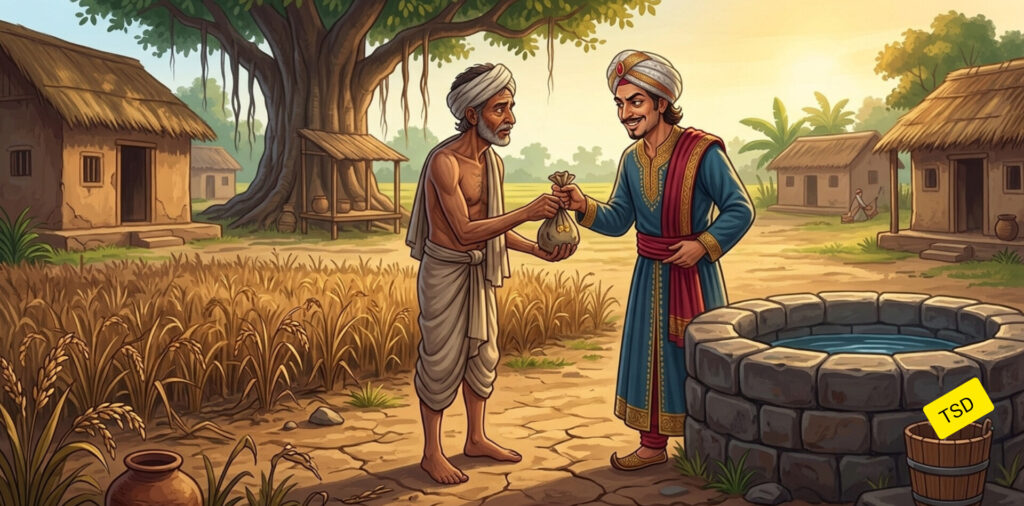
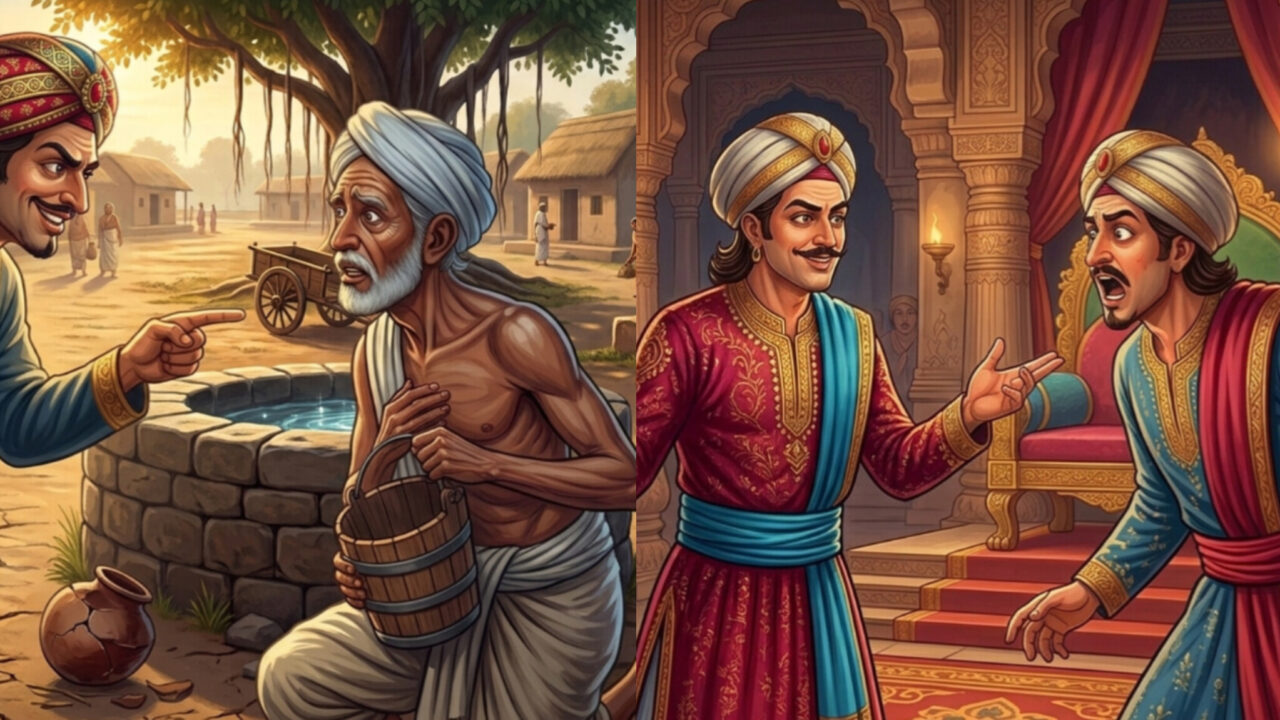
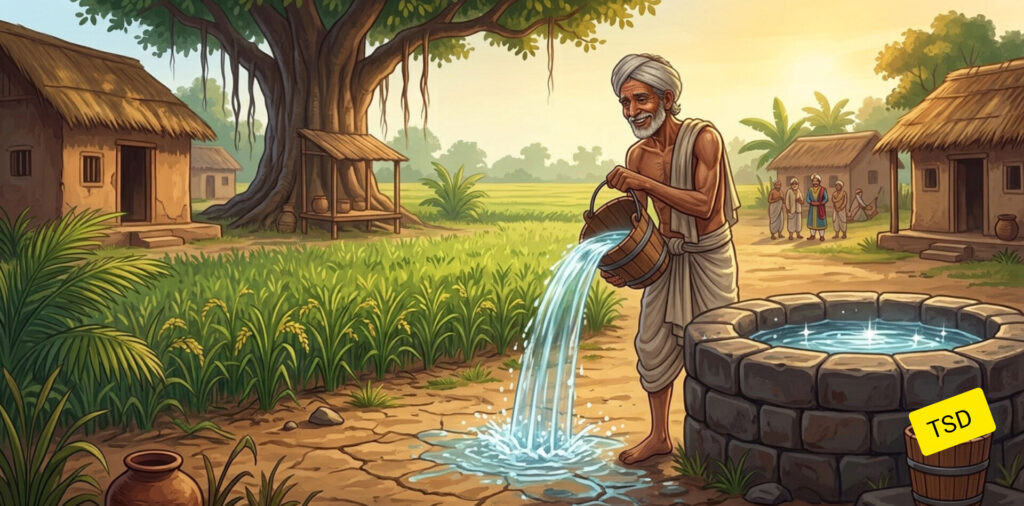
In a small village, a farmer watched his fields die of thirst season after season. He wasn’t lazy — he just had no water. His land sat right next to a well owned by a wealthy neighbor, close enough that it could have saved every crop he had.
So he did what anyone would do. He asked to buy it.
The two settled on a price. It took every rupee the farmer owned, plus money borrowed from three different relatives, but he paid it without complaint. A well of his own meant the end of years of worry.
The next morning, bucket in hand, he lowered the rope into the water. He hadn’t even pulled it halfway up before the rich man came running.
“Stop,” he said. “You cannot take that water. I sold you the well — the stones, the hole, the walls. I never said I sold you the water inside it. The water is still mine.”
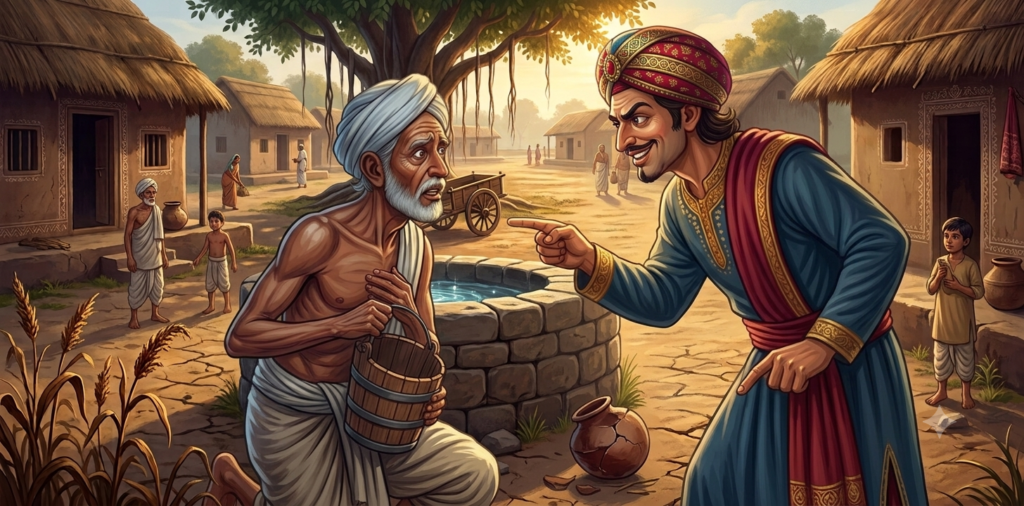
The farmer argued. He pleaded. He pointed out that a well without water is just a hole. None of it mattered. Technically, the rich man kept saying, their agreement had only ever mentioned “the well.”
Defeated, the farmer did the only thing left to do — he walked to the royal court and asked the emperor for justice.
Even Akbar Couldn’t Spot the Flaw at First
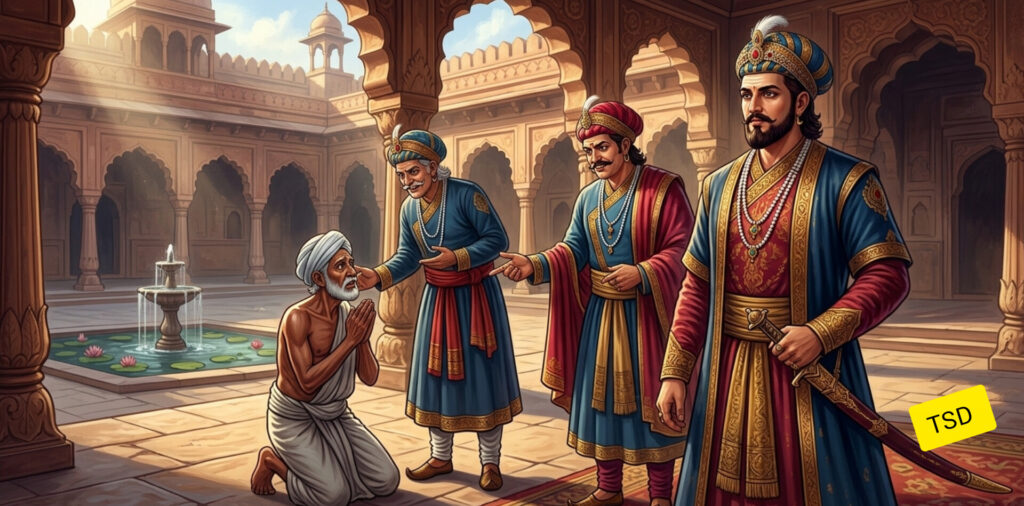
Akbar listened to the whole story and called the rich man in to explain himself. The rich man repeated his line word for word, calm as ever: “Maharaj, I sold him only the well. The water is still my property.”
Here’s the part most retellings skip — Akbar didn’t have an answer. He turned the argument over in his mind for a long while and admitted, even to himself, that the logic was too slippery to untangle on the spot. So he did what he always did when a case outsmarted him: he sent for Birbal.
It’s a small detail, but worth pointing out to your kids — even the emperor of Mughal India got stuck sometimes. Being smart isn’t about never being confused. It’s about knowing who to ask.
How Birbal Cracked the Case
Birbal heard both sides without interrupting once. Then he turned to the rich man with a single question.
“You say the well belongs to the farmer, and the water inside it belongs to you. Very well then — since your property is sitting inside another man’s land, you have two choices. Pay him rent, every single day, for storing your water in his well. Or remove every last drop of it, right now, and take it with you.”
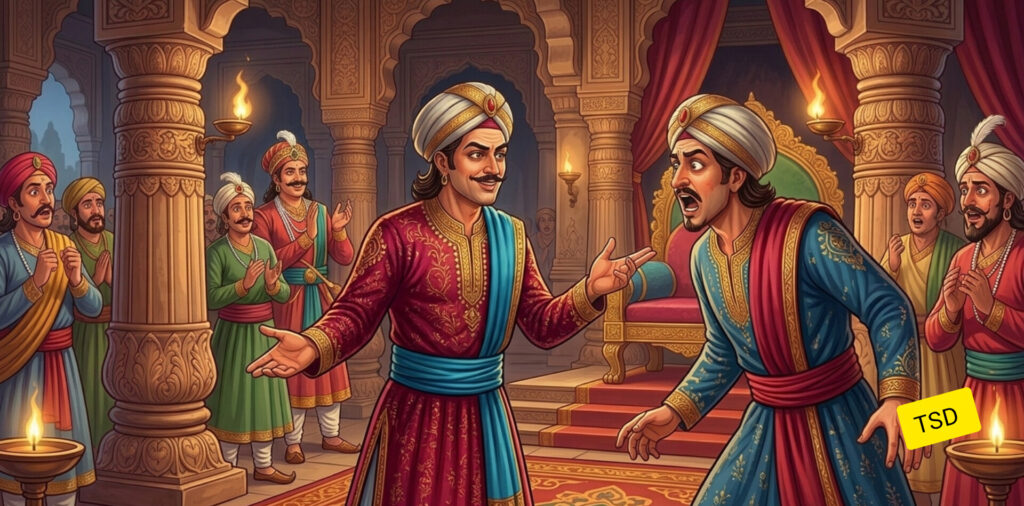
“You cannot own water without owning a place to keep it in.”
The rich man opened his mouth to argue and found there was nothing left to say. If the water was truly his, he couldn’t leave it sitting in someone else’s property for free. If he tried to remove it, he’d have to prove there was ever a way to separate “well” from “water” in the first place. Either way, the trap he’d built for the farmer had quietly become his own.
He fell at the farmer’s feet, admitted the whole scheme, and begged for pardon. Akbar fined him for the attempted fraud, and the farmer walked home with a well — and water — that was finally, completely his.
Why a Con Man Thought This Would Work
It’s worth pausing on the rich man for a second, because he wasn’t a cartoon villain twirling a mustache. He was almost certainly a man who’d spent his whole life winning arguments by being technically correct — the kind of trader who reads every contract twice, looking for the one line nobody else noticed. That habit had probably made him rich. It just met its match the one time someone smarter was in the room.
That’s really the whole story in one sentence: a clever trick worked right up until it met a cleverer question.
Why This Lands Perfectly With Kids Raised on “Terms and Conditions”
Here’s the modern version of the same trick, and your child has probably already lived through it: a free app that charges you the moment you tap one button too many, a streaming trial that “forgets” to mention the renewal date, a landlord who insists the broken heater “wasn’t in the lease.”
American kids grow up scrolling past pop-ups that say I Agree without reading a word. That’s exactly the trap the rich man built — a deal that only works because one side didn’t ask the right question. Telling this story doesn’t require explaining 16th-century Mughal land law. It just requires one sentence: “He tried to sell the wheel but keep the bicycle.”
That’s a plot twist any American third-grader gets instantly.
What Kids Take Away — Without Being Told
Nobody in this story stands up and announces the moral. They don’t need to. The rich man’s own trap does the talking. Kids who hear this walk away understanding two things on their own: cheating always leaves a thread someone can pull, and the sharpest response to unfairness isn’t yelling — it’s one calm, well-aimed question.
That’s the real reason Akbar Birbal stories have survived 400 years while so many other folk tales faded. Every single one is built the same way: an impossible puzzle, and a quiet, clever answer nobody saw coming.
Frequently Asked Questions
1.What is the Akbar Birbal story of water in the well?
A poor farmer buys a well from a wealthy neighbor, who then refuses to let him draw water — claiming he sold only the well, not what’s inside it. Birbal resolves it by forcing the rich man to either pay rent for storing his water in someone else’s well or remove it entirely, a condition he can’t meet.
2.What is the moral of “Water in the Well”?
The story shows, rather than states, that a dishonest deal collapses the moment someone asks the right question — and that patience and clear thinking beat shouting every time.
3.Why did the farmer go to Akbar’s court?
Because the rich man refused to let him use water from a well the farmer had legally and fully paid for, insisting their agreement covered only the physical well.
4.How did Birbal actually resolve the well-and-water dispute?
By turning the rich man’s own logic against him — if the water was separate property sitting on someone else’s land, he had to either pay rent for it or take all of it away immediately.
5.Is “Water in the Well” the same story taught in US or Indian Class 3/5 textbooks?
No. Many English textbooks carry an unrelated version — often with characters named Kasim and Ahmed — that shares only the opening idea. This is the Akbar Birbal court version, built around Birbal’s wit rather than a schoolbook moral.
6. Was Birbal a real historical figure, or just a folk-tale character?
Birbal was a real courtier in Akbar’s court, recorded in Mughal-era history as a trusted advisor. This specific tale, like most Birbal stories, is oral folklore — it doesn’t appear in official chronicles like the Akbarnama.
7.Hey Google — what did Birbal say about the well and the water?
Birbal told the rich man that since he claimed the water was his but the well belonged to the farmer, he had to either pay rent for keeping his water there or remove it completely — a trap he had unknowingly built for himself.
8.Are there other Akbar Birbal stories worth reading in English?
Yes — Birbal’s Khichdi, The Pot of Wisdom, Counting the Crows, and The King’s Ring all follow the same pattern: Akbar poses an impossible problem, and Birbal solves it with wit instead of force.
A Note from Daddy
I’ve told this one to my son more times than I can count, and it never gets old — mostly because he always tries to argue the rich man’s side first, just to see if he can win. Of all the Akbar Birbal stories in our house, this is the one that starts the most dinner-table arguments — in the best way.
Tonight’s tiny challenge: ask your child one question before bed — “If someone sold you a bicycle but kept the wheels, would that be fair?” Let them sit with it for a second. That’s Birbal’s entire argument, four centuries old, handed to a kid in one sentence.
More stories like this

The Wise Birbal and the Queen’s 1 Brother: A Tale of Wit and Wisdom : Akber and Birbal

Three Fish and the Power of Foresight : A Brilliant tell of 3 fish by Panchtantr