Sita Swayamvar Story in English| Ramayana
Last Updated: September 2026
Quick Facts
| Story | Sita Swayamvar |
| Location | Mithila (King Janaka’s kingdom, near today’s Nepal–India border) |
| Main Characters | Rama, Sita, Lakshmana, Sage Vishwamitra, King Janaka, Parashurama |
| Source | Valmiki Ramayana, Bala Kanda |
| Reading Time | ⏱ (Master Value — see Deliverable Table) |
| Main Lesson | Quiet strength beats loud pride |
Three things you didn’t expect from this story:
- It nearly ended in silence. Every king in the hall tried and failed — for a moment, King Janaka feared no one on Earth was worthy of his daughter.
- The unanswered question: why did an ordinary-looking teenage prince succeed where seasoned warriors — including Ravana himself, in some tellings — could not even move the bow an inch?
- The twist competitors skip: Rama’s wedding day wasn’t just his. All three of his brothers were married in the very same ceremony, to three sisters — a detail most retellings leave out entirely.
If you’ve ever watched your kid nail something on the first try that grown-ups had been overthinking for an hour, you already understand the feeling in that hall on the day of the Sita Swayamvar. It’s the moment every parent secretly loves — not because effort doesn’t matter, but because sometimes calm beats brute force, and a kid figures that out faster than anyone.
Sita Swayamvar is the contest in the Ramayana where Prince Rama of Ayodhya won princess Sita’s hand by lifting and breaking Lord Shiva’s divine bow, the Pinaka, in the court of King Janaka at Mithila (Valmiki Ramayana, Bala Kanda). It reads like a legend, but the shape of it — a near-impossible challenge, a room full of overconfident adults, and one calm kid who wasn’t trying to prove anything — is something any household with a strong-willed child will recognize.
The Bow With a Two-God History
Long before it ever reached Mithila, the Pinaka had a history stranger than most weapons in any story. According to tradition, the divine architect Vishwakarma once built two matching bows to settle an argument among the gods about whose power was greater — Shiva’s or Vishnu’s. Shiva’s half of that contest became the Pinaka; Vishnu’s half became a bow called Sharanga, which would later end up in the hands of a very different, very furious sage named Parashurama (a detail that matters more than it seems, later in this story).
Shiva eventually passed the Pinaka down to the royal family of Mithila for safekeeping, and it stayed there for generations — never used, never even properly lifted, sitting in the palace like a locked door nobody had the key to.
Why Was There a Contest for Sita’s Hand?
Sita wasn’t an ordinary princess, and King Janaka knew it. As a child, Sita had once lifted the massive Pinaka with ease while playing — something grown men in the palace could barely shift. Janaka never forgot it.
So when it came time to find Sita a husband, he didn’t ask for wealth or a royal bloodline. He set one condition: whoever could string the Pinaka would marry his daughter. It wasn’t a test of muscle. It was a test of who Sita actually needed standing next to her.
Think of it less like a wrestling match and more like a locked door only the right key could open — every visiting prince got a turn, and every single one walked away empty-handed.
Before the Bow Broke: A Garden, Flowers, and One Glance
There’s a quieter scene that happens before any of the drama with the bow, and it’s easy to miss if you only know the “highlight reel” version of this story. The morning after Rama and Lakshmana arrived in Mithila, their guru sent them out to gather flowers for the morning prayers. At the same time, Sita had gone to the same garden with her friends, sent by her mother to offer prayers to the goddess Girija before the swayamvar.
The two groups crossed paths by accident. Neither Rama nor Sita said a word to each other — in the story, that single glance is treated as the real beginning of everything that follows, long before anyone touched the bow (a scene told in detail in classical retellings such as Tulsidas’s Ramcharitmanas). It’s a small, almost accidental moment tucked inside a much bigger legend, and it’s part of why this story has stayed alive for thousands of years: the biggest moments aren’t always the loudest ones.
The Swayamvar Sabha: When the Bow Wouldn’t Move
Kings, princes and warriors from across the land arrived at Mithila, certain that strength alone would win the day. One by one, they stepped up to the bow. Not one of them could even rock it.
King Janaka’s patience finally broke. In front of the entire hall, he said what everyone was thinking but no one dared say aloud:
“Is there truly no warrior left on this Earth who can lift this bow?”
The silence that followed was heavier than the bow itself.
How Rama Arrived With Vishwamitra
Rama hadn’t come to Mithila to compete. He and his younger brother Lakshmana were traveling with their guru, Sage Vishwamitra, after helping protect the sages’ forest rituals from demons on the way. An invitation from King Janaka had simply brought them through Mithila at the right moment.
When Janaka’s frustration filled the hall, Vishwamitra turned to his young student and gave him a quiet nod: go ahead. Rama didn’t argue, and he didn’t posture. He bowed to his guru, walked up to the bow that had defeated every seasoned warrior in the room, and lifted it as if it weighed nothing at all.
As he strung it, the bow cracked in half with a sound the Ramayana describes as loud enough to shake the earth (Valmiki Ramayana, Bala Kanda).
Parashurama’s Anger — and Why It Faded
The sound reached Sage Parashurama, the fierce warrior-sage devoted to Lord Shiva, and he arrived at the hall furious that his god’s bow had been broken. He wasn’t looking for a fight for its own sake — Parashurama had spent his life defending dharma, and to him, that shattered bow looked like disrespect.
Lakshmana, protective of his brother, answered back sharply, which only sharpened Parashurama’s anger further. But Rama didn’t raise his voice or match anyone’s temper. He stepped forward, bowed, and offered something closer to an apology than a defense:
“O sage, treat me however you wish. Whatever pleases you most, give me your command — I will accept it gladly.”
There was nothing showy about it. No taking credit, no defending his own strength. And that, more than the broken bow itself, was what convinced Parashurama that the “boy” standing in front of him was no ordinary prince. His anger didn’t vanish because Rama proved he was stronger — it faded because Rama refused to compete with it at all.
It’s a small moment, but it’s the heart of the whole story: nobody in this hall wins by shouting the loudest. Not the kings who tried to force the bow, not Lakshmana in his brother’s defense, not even Parashurama. The only person who stayed steady the entire time was Rama.
The Wedding — and the Detail Most Retellings Leave Out
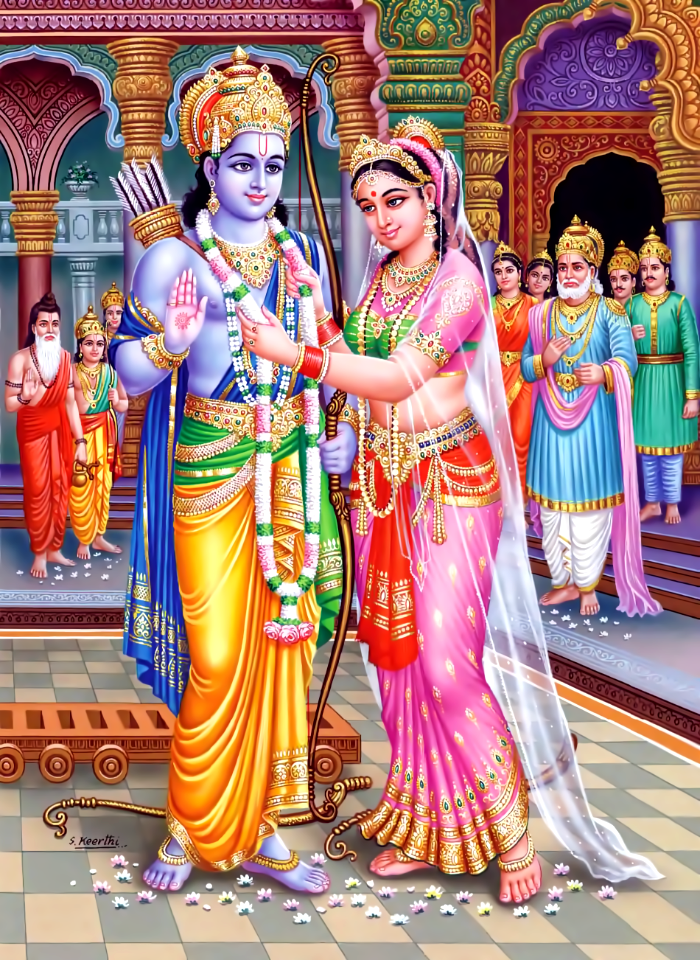
With the bow broken and the condition met, Sita placed a garland around Rama’s neck, accepting him as her husband in front of the entire court. Messengers rushed to Ayodhya to tell King Dasharatha the news.
Here’s the part almost no other retelling includes: this wasn’t just Rama and Sita’s wedding. In the same ceremony, Sita’s three sisters and cousins — Urmila, Mandavi and Shrutakirti — were married to Rama’s three brothers, Lakshmana, Bharata and Shatrughna. Four brothers, four brides, one ceremony (corroborated across multiple sources, including the Wikipedia pages for Shatrughna, Bharata and Urmila). It’s the kind of detail that turns a single wedding into the founding of an entire family — which is exactly what it was.
A Thought for Parents
You don’t need a divine bow in your living room to recognize this story. Every parent has watched a room full of louder, more confident people struggle with something their own quiet kid handled without fuss. The Sita Swayamvar isn’t really about archery — it’s about the difference between trying to look strong and actually being ready.
A Verse Worth Keeping
⚠️ PROOF RULE flag — needs Devendra’s input: I looked for a specific chaupai to anchor to this exact scene (the garden meeting or the bow-breaking) and could not independently confirm one strongly enough to cite it here with confidence — this is a case where “यह मेरा अनुमान है” applies, so I’m leaving the verse blank rather than guessing. If you have a specific chaupai from your own Gita Press/Ramcharitmanas copy for this scene, send it and I’ll drop it in with the English meaning alongside it.
Frequently Asked Questions
What is the story of Sita Swayamvar?
Sita Swayamvar is the contest King Janaka of Mithila held to choose a husband for his daughter Sita: whoever could lift and string Lord Shiva’s divine bow, the Pinaka, would marry her. Prince Rama of Ayodhya was the only one able to do it, and the bow broke in the process (Valmiki Ramayana, Bala Kanda)
Which sage brought Rama to the Sita Swayamvar?
Sage Vishwamitra brought Rama and his brother Lakshmana to Mithila. They were already traveling with him after helping protect his forest rituals, and it was Vishwamitra who gave Rama permission to attempt the bow.
Did Ravana attend Sita’s Swayamvar?
In several popular retellings of the Ramayana, Ravana is described as attending and attempting to lift the bow, but failing along with every other king present. This detail varies between versions and regional tellings, and isn’t found the same way in every source — so treat it as a well-known popular addition rather than a single confirmed fact.
Why couldn’t the other kings lift Shiva’s bow?
The Ramayana frames the bow as something that could only be lifted with humility and readiness, not raw strength — which is why kings who approached it with pride and confidence couldn’t even move it, while Rama, who bowed to it first, lifted it with ease.
How old was Rama when he broke Shiva’s bow?
Most traditional tellings place Rama as a teenager at the time of the swayamvar — old enough to travel and train with Sage Vishwamitra, but still young compared to the seasoned kings competing against him.
Is the “swayamvar” custom just a story, or was it a real practice?
Textbooks describe swayamvar as a documented ancient Indian custom in which a woman of royal birth could choose her own husband from assembled suitors — a genuine historical practice, not something invented for the Ramayana. The Sita Swayamvar in the epic is the most famous story built around that real custom, which is why the two get blended together in casual conversation.
Sita Swayamvar Story in English — Key Vocabulary
| Hindi Word | Transliteration | English Meaning |
|---|---|---|
| स्वयंवर | Swayamvar | A ceremony where a bride chooses her own groom |
| धनुष | Dhanush | Bow |
| तपस्या | Tapasya | Deep meditative penance |
| गुरु | Guru | Teacher or spiritual guide |
| आशीर्वाद | Ashirwad | Blessing |
Tonight’s Question for Your Kid
You don’t need a big lesson or a lecture tonight. Just ask one simple question before bed: “If you had to prove you were ready for something big, would you rather show off — or just quietly get it done?” Let them answer however they want. That’s the whole story, right there.
From Daddy
I’ve retold this one to my own kids more times than I can count, and it’s never the bow-breaking that gets them — it’s Janaka’s one line of despair before Rama even shows up. Every kid knows what it feels like to watch grown-ups give up on something too early. This story is really about what happens right after that moment.
About the Author
This story was retold by Devendra Vyas, founder of TellMeStoryDaddy.com, who writes Ramayana and Panchatantra stories for bedtime reading with families around the world. Read more about the site on the [About page].
- LINK 1 (Sibling Post): इस English post से किसी published English/Ramayana-adjacent TSD story का link — जिस paragraph में Rama-Lakshmana-Vishwamitra का ज़िक्र है, वहाँ लगाओ।
- LINK 2 (Category Parent Page — Silo): English/Ramayana category की parent page — article के अंत में (“From Daddy” section के बाद) लगाओ।
- LINK 3 (Hindi↔English pair): मौजूदा bilingual post (
/swayamvara-of-sita/) — दोनों posts में एक-दूसरे को “इसे [Hindi/English] में पढ़ें” वाला link दो।
Thousands of years before this Swayamvara ceremony Once Maharishi Kanva performed severe penance for Brahmadev.He continued performing penance without moving for years. Due to which termites made an anthill on his body and a bamboo tree grew on that anthill, which was not ordinary. Brahma Dev was pleased with the penance of Maharishi Kanva and granted him the boon he desired and gave that bamboo to Lord Vishwakarma. The Vishwakarma ji made two powerful bows, Sharang and Pinaka. He gifted Sharanga to Shri Hari Vishnu and Pinaka bow to Lord Shiva. Lord Shiva used this bow to kill Tripurasura and handed it over to the Devas. The Devas handed over this bow to Devarat, the ancestor of King Janak. That bow of Lord Shiva was safe with king Janak as his heritage.
No one had the ability to lift this Shiva bow. Once Goddess Sita ji had lifted this bow, due to which Janak ji came to know that this was not an ordinary girl. Whoever marries her should not be an ordinary man, that is why Janak ji had organized Sita ji’s swayamvar and had set a condition that whoever picks up and breaks this Shiva bow, Sita ji will marry him.Guru Vishwamitra arrived at the appointed time with his disciples Ram and Lakshman. Swayamvar started and gods, demons, yakshas and gandharvas also came from everywhere. Everyone tried to break the bow but no one could even move it. Feeling sad, King Janak angrily said to everyone, “Is there no warrior in this world who can break this bow?”
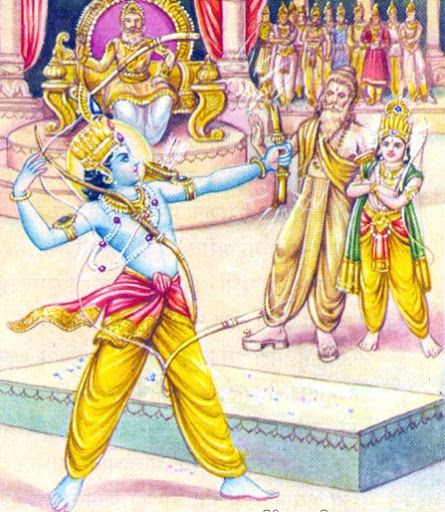
On this, Vishwamitra ji permit Prince Ram to participate in the competition. After Guru’s permission, he moved towards the bow and picked it up very easily and as he bent it to put the string on it, it broke. There was a terrible thunderous sound due to the breaking of Lord Shiva’s bow.
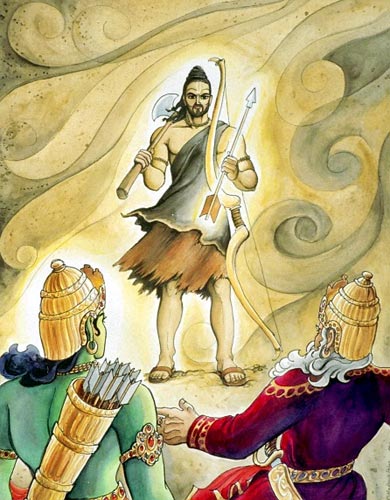
Hearing the voice, Lord Parshuram appeared there and seeing the bow broken, he became very angry, But when Parashurama came to know that the one who broke the bow was none other than Shri Ram, the Avatar of Lord Vishnu, his anger subsided. Lord Ram and his marriage with Goddess Sita got completed. Vishwamitra ji reached Ayodhya Kingdom with the new couple where they all received a grand welcome.
सीता जी का स्वयंवर: देवी सीता और भगवान राम की शादी
ताड़का वध के बाद जब गुरू विश्वामित्र,भगवान राम और लक्षमण पुनः अयोध्या लौटने की तैयारी कर रहे थे । उसी समय जनकपुरी के राजा जनक की ओर से गुरु विश्वामित्र को एक निमंत्रण प्राप्त हुआ । राजा जनक ने अपनी पुत्री सीता का स्वयंवर रखा यानि उस दिन देवी सीता अपने लिए योग्य पति का चयन करेगी ।
सीताजी के स्वयंवर से हजारों साल पहले एक बार महर्षि कण्व ने ब्रह्मदेव की घोर तपस्या की। अपने ध्यान में इतने गहरे खो गए कि वर्षों तक बिना हिले तपस्या करते रहे। जिससे उनके शरीर पर दीमको ने बाँबी बना ली। उस बाँबी पर बांस का एक पेड़ उग आया, जो साधारण नहीं था। ब्रह्म देव ने महर्षि कण्व की तपस्या से खुश होकर उन्हें उनके मनचाहे वरदान प्रदान किये और उस बांस को भगवान विश्वकर्मा को दे दिए। इनसे विश्वकर्मा जी ने उनसे 2 शक्तिशाली धनुष शारंग और पिनाक बनाए। श्री हरि विष्णु को उन्होंने शारंग और भगवान शिव को पिनाक धनुष प्रदान किया। भगवान शिव ने इस धनुष को त्रिपुरासुर को मारने में उपयोग किया और देवों को सौंप दिया। जब देवों का समय खत्म हुआ तो देवों ने यह धनुष राजा जनक के पूर्वज देवरात को सौंपा गया। शिवजी का वह धनुष उन्हीं की धरोहर स्वरूप जनक जी के पास सुरक्षित था। इस शिव-धनुष को उठाने की क्षमता कोई नहीं रखता था।
एक बार देवी सीता जी ने इस धनुष को उठा दिया था, जिससे प्रभावित हो कर जनक जी जान गए कि यह कोई साधारण कन्या नहीं है। जो भी इससे विवाह करेगा, वह भी साधारण पुरुष नहीं होना चाहिए इसीलिए जनक जी ने सीता जी के स्वयंवर का आयोजन किया था और यह शर्त रखी थी कि जो कोई भी इस शिव-धनुष को उठाकर तोड़ेगा, सीता जी उसी से विवाह करेंगीं ।
तय समय पर गुरू विश्वामित्र अपने शिष्य राम और लक्ष्मण के साथ जनकपुरी पहुंचे । स्वयंवर शुरू हुआ, वहां हर जगह से देव, दानव,यक्ष और गंधर्व भी आए हुए थे । सबने धनुष तोड़ने की कोशिश की पर कोई उसे हिला भी नहीं पाया ।
दुःखी होकर राजा जनक ने पूरी सभी में क्रोध से कहा कि “क्या इस सृष्टि में ऐसा कोई योद्धा नहीं जो इस धनुष को तोड़ सके ?” इस पर विश्वामित्र जी ने राजकुमार राम को प्रतियोगिता में शामिल होने का आदेश दिया । गुरू की आज्ञा पाते ही राम धनुष की ओर बढ़े और बड़ी आसानी से धनुष की उठाया और उस पर प्रत्यंचा चढ़ने के लिए जैसे ही उसे मोड़ा वह टूट गया । भगवान शिव के धनुष के टूटने से बहुत भयंकर गर्जना हुई । आवाज सुनकर भगवान परशुराम वहां प्रगट हुए और धनुष टूटा देख उन्हें बहुत क्रोध आया लेकिन लेकिन जब परशुराम को यह ज्ञात हुआ कि धनुष तोड़ने वाला कोई और नहीं बल्कि भगवान विष्णु के अवतार श्री राम हैं तो उनका गुस्सा शांत हुआ। इस प्रकार भगवान राम ने और सीता से उसका विवाह सम्पन्न हो गया। इसके बाद विश्वामित्र जी नए युगल के साथ अयोध्या पहुंचे जहां उनका भव्य स्वागत हुआ