Ruru Jataka: The Golden Deer
July 2026
Imagine you secretly helped a classmate during a test — and all you asked in return was that they never tell anyone it was you, since you’d get in trouble. They promised. The next day, when the teacher offered a reward for naming who helped, they gave up your name without a second thought. That sting is exactly where the Ruru Jataka begins
The Ruru Jataka is Jataka Tale #482 (Ruru-Migaraja-Jataka; Jatakamala No. 26) — the Buddhist story of the Buddha’s previous birth as Ruru, a golden deer who saves a drowning man and is betrayed by him for a royal reward. In China, this same tale became the famous “Nine-Colored Deer” of the Dunhuang cave paintings. Here is how Daddy tells this story.
| Story | Descriptions |
|---|---|
| Story | Ruru Jataka — The Golden Deer |
| Source | Jataka Tales #482; Jatakamala No. 26 (Buddhist canon) |
| Main Characters | Ruru (the Bodhisattva), the rescued man, the King, the Queen |
| Setting | Forest by the river; a kingdom near Varanasi |
| Reading Time | 6 minutes |
| Moral | Gratitude, keeping promises, forgiveness |
- 💔 The man Ruru pulled out of the river was the very man who led the king’s arrows straight to him.
- ❓ When the king’s arrow pointed at his heart, why did Ruru ask him to reward the traitor instead of punishing him?
- ✨ In this telling, Ruru himself gathers forest herbs and cures the ailing queen — an ending you will not find anywhere else.
Who Was Ruru, the Golden Deer?
Before you learn what Ruru looked like, know this: everything that happens later in this story only works because he was compassionate to a species that hunted his kind. Keep that in mind as you read on.
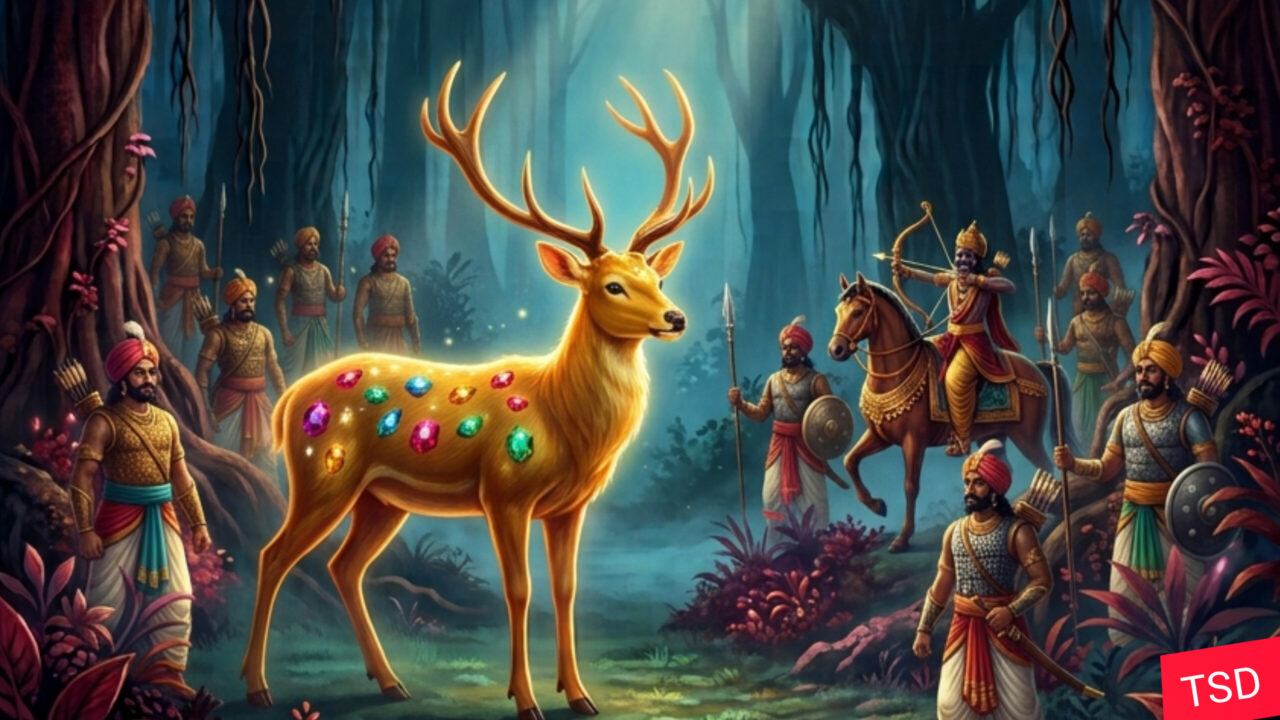
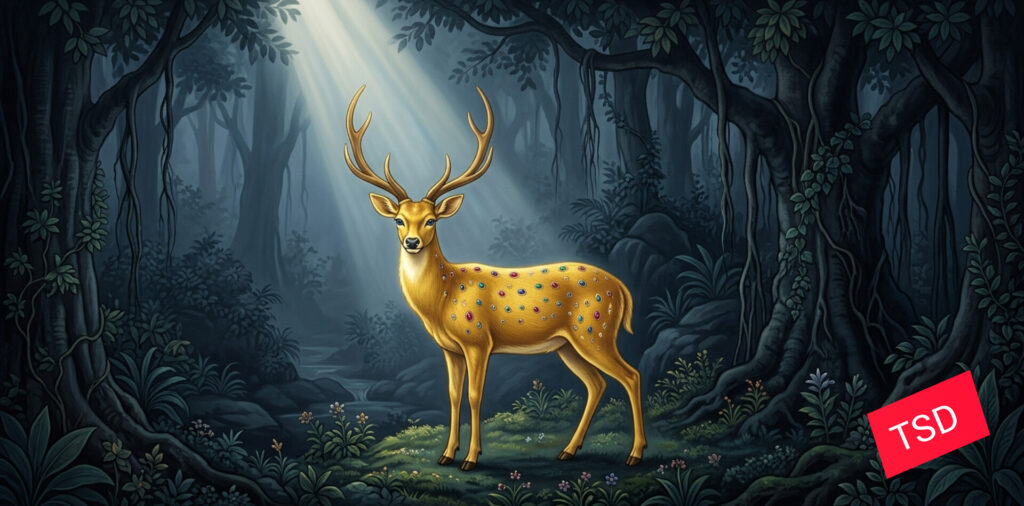
His beautiful golden-hued body was adorned with the brilliance of rubies, sapphires, and emeralds. His velvety, smooth hair, sky-blue eyes, and finely carved antlers were naturally captivating. Whenever he roamed in the forest, everyone who caught a glimpse of him couldn’t help but sigh in awe.
Undoubtedly, Ruru was not an ordinary deer. His unparalleled beauty was his uniqueness. Yet, even more significant was his wisdom; he could converse with humans just like them. Ruru earlier lived in the ashram of a famous sage from whom he had knowledge of the herbs of the forest. After the death sage, fed up with the behavior of his successors, Ruru left the ashram and preferred to live independently in the forest.
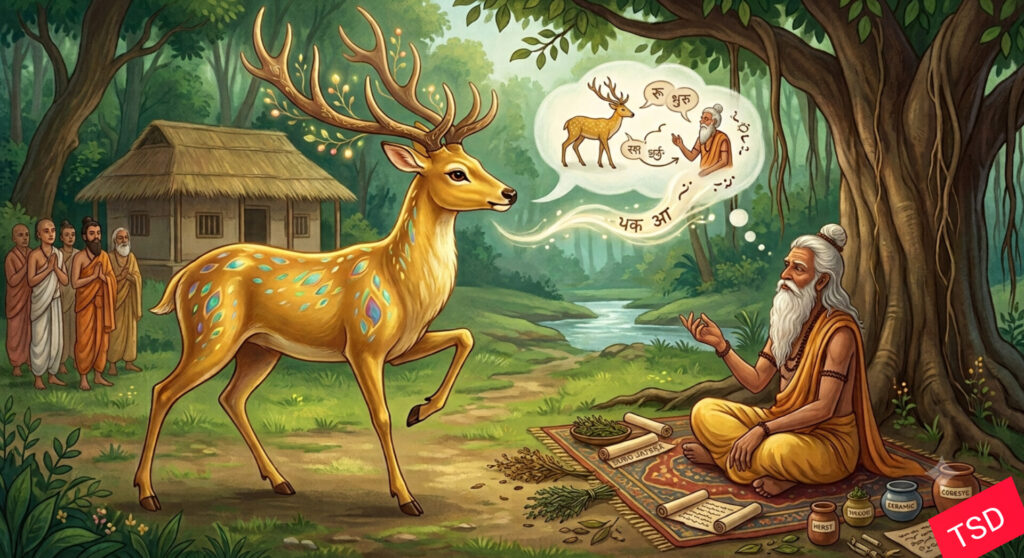
Now he used to help the animals of the forest with the herbs which were easily available there and was loved by everyone. Due to his past life experiences, his compassion for all living beings was unparalleled, and there was no exception for humans.” This compassion was Ruru’s greatest virtue — but as you’ll see, compassion this deep isn’t always calm. It costs something.
How Did Ruru Save the Drowning Man?
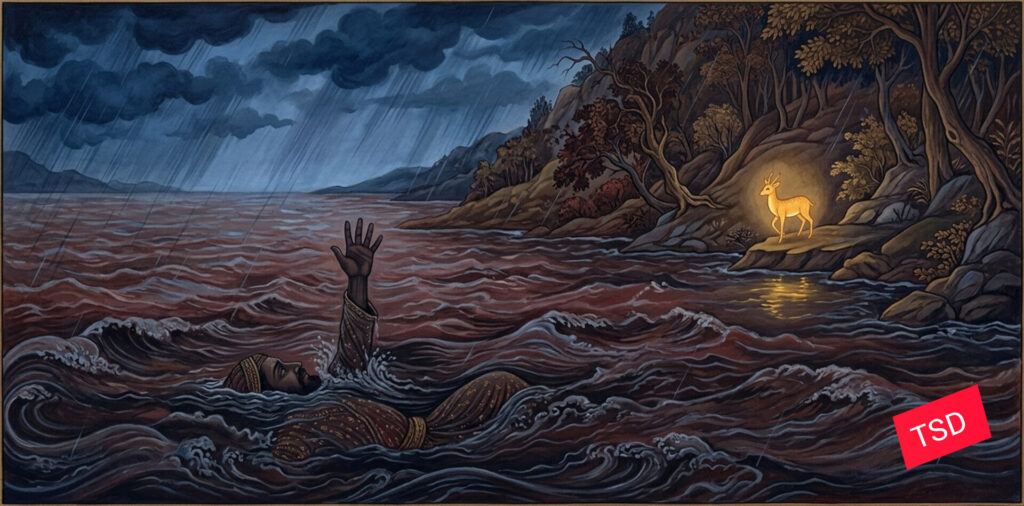
One day, while leisurely strolling through the forest, Ruru heard someone crying. Following the sound, he discovered a man being swept away by the current of a mountain stream. Ruru’s compassion immediately surged, prompting him to leap into the water and offer his hind legs for the drowning man to grab onto. Instead of clutching Ruru’s legs in his panic, the man found himself safely perched on Ruru’s back.
Ruru felt the man’s panicked grip dig in harder than he expected, and for one instant he wasn’t sure he could carry the weight to shore at all — but he didn’t let go. Though Ruru could easily have shaken him off, he showed great restraint and carried the struggling man to the shore after overcoming several challenges.
When the rescued man tried to express his gratitude, Ruru said, ‘If you truly want to thank me, do not reveal to anyone that you have been saved by a special golden deer, for the people of your world, upon learning about my existence, would undoubtedly seek to hunt me down.” Think of Ruru’s request like asking a friend to keep your address private. It wasn’t a big favor. It was one sentence, easy to keep. Ruru bid farewell to the man and returned to his dwelling.
Why Did the Man Betray Ruru?
“In due course, the queen of a nearby kingdom, who was deeply distressed by her illness, had a dream. In her dream, her ancestral goddess revealed the cure for her illness in a golden deer that lived in the nearby forest.
She immediatelyimplored the king to find the golden deer for her. Deeply in love with his queen and worried about her illness, the king could not ignore her prayer.
The King declared that whoever found the mythical deer, the queen had dreamed of would be rewarded with a village and ten beautiful maidens, Even though he didn’t believe in dreams.
The man Ruru had saved was, as far as we know, no one important — just someone who’d nearly drowned in a river one ordinary day. A village and ten attendants was more wealth than he could earn in three lifetimes. That’s not an excuse. It’s the reason the temptation worked at all — easy promises are only easy to keep until the price of breaking them turns life-changing.
The same man whom Ruru had saved overheard the proclamation. Knowing Ruru’s whereabouts, he hurriedly made his way to the king’s palace. Breathless, he recounted the entire story of his rescue by Ruru.
What Happened When the King Met Ruru, the Golden Deer?
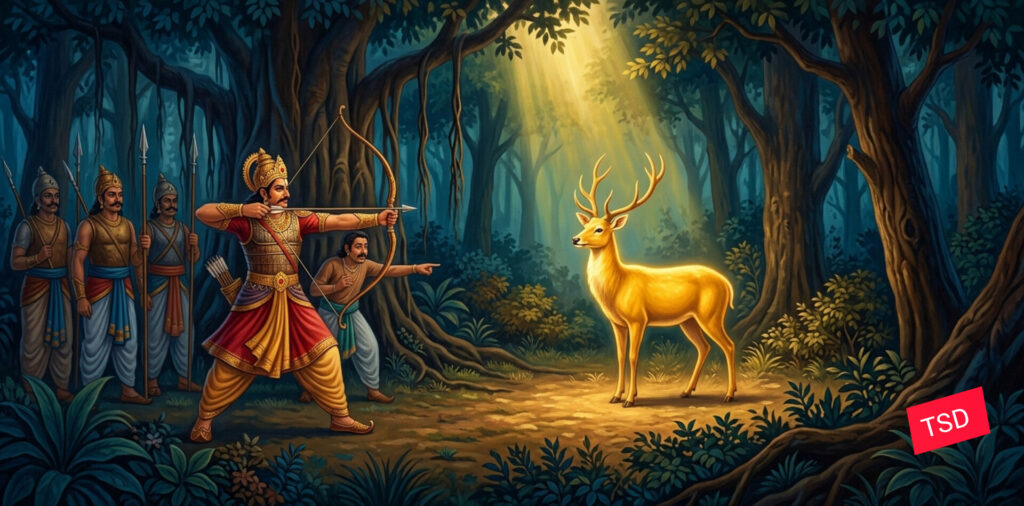
Without wasting a moment, the king and his soldiers, accompanied by the man, reached the forest and surrounded Ruru’s dwelling. Seeing the deer, the king was overjoyed and surprised. He pointed an arrow to wound the deer, but suddenly the deer said in the voice of a man, “O king, you should trust the talking deer but not the human who can talk.
” The king stopped and asked the talking deer to explain. The deer said that this man was going to die in the river and i jumped into the water for his life but for some amount of money he sold his soul and told you about me. Ruru then divulged the entire story of the man’s drowning and rescue. The king got angry at the man who broke his promise for money.
In response, the king turned his arrow towards the man whom Ruru had saved. The deer once again talk ‘O king’ I took it as a act of God so don’t take his life. Forgive him for my sake. On this the king said, ‘O golden deer, the cure for my queen’s illness is a golden deer, this is what the goddess told her in the dream of my queen. I kept a reward to entertain the queen so that she would feel that efforts were being made to cure her illness.”
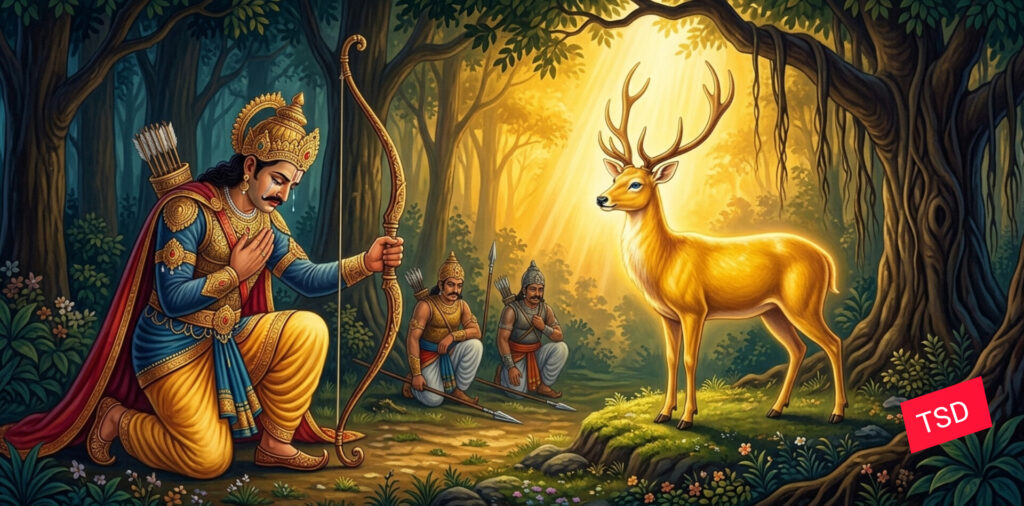
Now this man has put me in a dilemma. Because of this I have to choose between the sacred deer or the lovely but sick queen and I do not want to incur the sin of killing a pure soul like you.”
Upon this, the deer said “it is true that I am the cure for your queen, but not my meat. Let me take some herbs from this forest which will definitely cure your queen.” Saying this, the deer plucked the wild herbs around him with his mouth and set out towards the palace.
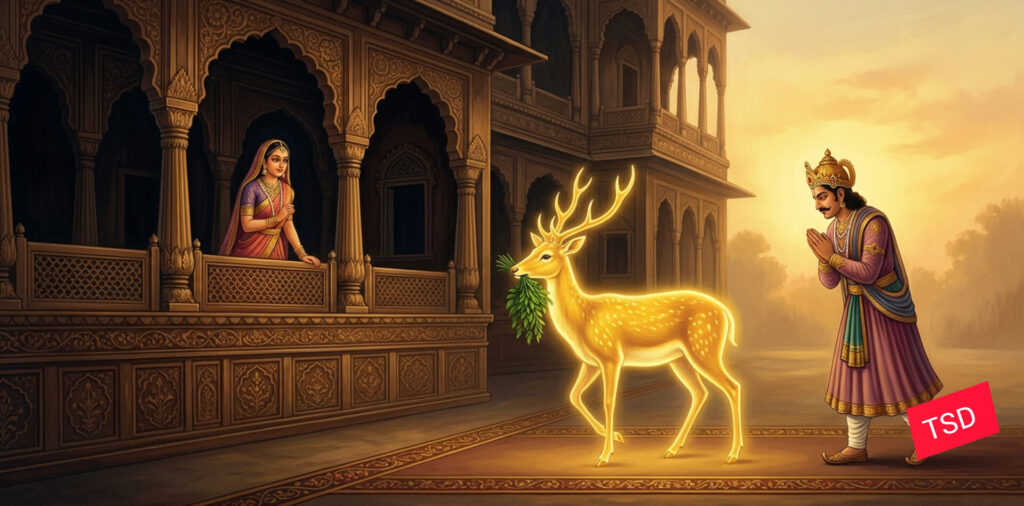
The deer went ahead with the herbs in its mouth and the king and his entourage followed and reached the palace. The herbs were given to the queen and within a few days the queen recovered. The deer stayed in the palace for some time of its own free will and then happily bid farewell to the king and returned towards the forest.
“It is better to pull a drowning log from the river than to save an ungrateful man.” — Ruru’s words in the Ruru-Migaraja-Jataka (No. 482, Pali Jataka collection)
Meaning: A log at least becomes useful; an ungrateful person returns kindness with harm. This one line is the heart of the Ruru Jataka.
Where Else Has This Golden Deer Been Told?
The Ruru Jataka isn’t only a story on a page — it’s carved and painted across centuries. In India, it appears in a 2nd-century BCE stone relief at the Bharhut stupa, one of the oldest surviving pieces of Buddhist narrative art. A few centuries later, it was painted again in Cave 2 and Cave 17 at Ajanta. The story then travelled to China, where it evolved into the “Nine-Colored Deer” of the Dunhuang cave murals — later adapted into a well-loved 1981 animated film by Shanghai Animation Film Studio. Three cultures, three different art forms, one same golden deer.
💭 A Thought for Parents: You don’t need a temple visit to hand this down. Next time your child helps someone without being asked to, name it out loud — “that’s the Ruru in you.” That’s the whole lesson, delivered in one sentence, no lecture required.
What This Story Teaches Our Children
- Kindness without conditions — Ruru knew humans hunt deer, yet he leapt into the flood without a second thought.
- A promise is sacred — the villain of this story is not a demon; it is a broken word.
- Forgiveness is strength — Ruru asked the king to spare his own betrayer. That is why the wise call him the Bodhisattva.
Daddy’s Note: When I told this story to kids, they went quiet after the betrayal. Then they asked, “Daddy, why did Ruru still forgive him?” Answer is .. “anyone can be kind when it is safe. Ruru was kind when it was dangerous, and forgiving when it hurt. That is the heart I wish for you.”
FAQ — Ruru Jataka
What is the Ruru Jataka?
The Ruru Jataka is Buddhist Jataka Tale #482, the story of the Buddha’s previous birth as a golden deer named Ruru. He saves a drowning man, is betrayed by him for a royal reward, and answers that betrayal with forgiveness.
What is the story of the golden deer?
The golden deer Ruru rescues a drowning man who promises secrecy, but the man betrays him when the king announces a reward. The truth moves the king, and Ruru himself gathers forest herbs that cure the ailing queen before returning free to his forest.
Is Ruru the same as the golden deer in the Ramayana?
No — the Ramayana’s golden deer was Maricha, a demon in disguise sent to deceive Sita, while Ruru is the Bodhisattva from the Buddhist Jataka tales. Two different golden deer, two completely different stories.
What is the Nine-Colored Deer?
The Nine-Colored Deer is the Chinese version of the Ruru Jataka, painted in Cave 257 of the Mogao Grottoes at Dunhuang and adapted into a beloved 1981 animated film by Shanghai Animation Film Studio.
What is the most famous Jataka tale?
The Vessantara Jataka is traditionally called the most famous, while the Ruru Jataka (Golden Deer), Sibi Jataka, and Mahakapi Jataka are among the most loved as children’s bedtime stories.
Hey Google, what is the moral of the Ruru deer story?
The moral of the Ruru deer story is: help others without expecting reward, never break a promise, and answer betrayal with forgiveness instead of revenge.
Is “A Deer of Nine Colors” the same as this story?
The ancient version is — it’s the Chinese Dunhuang cave-mural retelling of the Ruru Jataka described above. A modern short film with a similar name, “A Deer of Nine Colors” (2013, directed by Andrew Thomas Huang), is a separate, unrelated artwork inspired by the same legend.
Is the Ruru Jataka a real scripture, or just a folk story?
It’s canonical Buddhist scripture — Jataka Tale #482 in the Pali Canon, one of the Buddha’s documented past-life stories used in Buddhist teaching for over two thousand years. A more poetic retelling, the Jatakamala (by the poet Arya Sura), is a separate, later Sanskrit version of the same story — same plot, different literary tradition.
Is the Ruru Jataka a real scripture, or just a folk story?
It’s canonical Buddhist scripture — Jataka Tale #482 in the Pali Canon, one of the Buddha’s documented past-life stories used in Buddhist teaching for over two thousand years. A more poetic retelling, the Jatakamala (by the poet Arya Sura), is a separate, later Sanskrit version of the same story — same plot, different literary tradition.
Tonight’s easy one: Ask your child one question before bed — “If someone didn’t say thank you, would you still help them again?” Just listen to what they say. No right answer needed tonight.
Love Jataka tales? Read the Rabbit on the Moon story next — another beautiful tale of the Buddha’s past lives. You can also enjoy.

What kind of information do you want ? Our email I’d is tellmestorydaddy@gmail.com 😍 write me if possible
It’s not hard Because for technical need I hired a technical team. They are very intelligent and complete your need what you want and sometime even better. it’s affordable too, if you need I can give you details.
[…] The moral of “Water in the Well” is that dishonesty always carries the seeds of its own defeat — a clever lie may work for a day, but it cannot survive a clever question. The rich man’s trick depended on splitting one whole thing — a well full of water — into two separate “properties.” Birbal’s genius wasn’t inventing a new rule; it was simply taking the rich man’s own logic and following it one step further than the rich man himself was willing to go. Read more English stories.…. […]